Showing posts with label 1960s. Show all posts

Tuesday, May 23, 2017

MY FAMOUS BALL COAT IN 1968

As I was searching through some recent folders I came across this ball coat worn by Vogue Italia editor, Franca Sozzani - in a photo of the Boston Globe, March 29, 2012. I certainly beat the timing of her ball coat with my ball coat designed in a collection in 1968. I designed the white mink helmet and the "boottops over shoes" to go with - very 1960s.
Please remember we are still open to more students to learn fashion design patterns online free, and cooperate with us on a book. For more information email
And please comment. 


Friday, March 08, 2013

True Fashion Design is a Moving 3-D Sculpture


  The Boston Globe had a photo today of (above) one of the most beautiful stoneware sculpture by H. Nakashima at the Museum of Fine Arts. It prompted me to think about the beautiful 3-D curves in great fashion design. Nakashima’s sculpture has a feeling of motion in observing it, but fashion is greatest when on a moving human body.


  One of my proudest 3-D fashion sculptures is a 6-ply pure silk crepe I sold to Neiman-Marcus in 1958. (left) The cape sleeves start as a sleeve in the front, form a cape in the back and come around to the front to finish as a sleeve. It moves beautifully when moving your arms.  


  Another of my favorites that illustrates fashion as a great moving 3-D sculpture is my “Sunburst” dress, of bright orange silk pesante.(left) The accordion pleating goes all around the body and comes together in one point in the front, finishing with a sunburst pin. The pleating had an amazingly beautiful motion as the woman walked. The photo was in a full page article in the Boston Sunday Herald in 1962. It was also a favorite of my customers, who bought many of them. 

  Both of these styles required great expertise in sculpting fabric in outer space, feeling the motion in “inner visualization” – not fitting tightly to a dress form or model, as so many young designers learn to do when draping today – or when being committed to the rules of drafting. As Frank Gehry, the famous architect and jewelry designer, said, “Beauty without rules.”
 

Saturday, December 16, 2006

1968 Ball Coat - Inspiration, Apollo Mission


In 1968 I was inspired by the Apollo Mission, the first time astronauts went around the moon. The moon as a ball was the inspirational 3-D shape. The outside shell was in a heavy worsted wool, cut into spherical slices for shaping as a ball, much like we do with the global ball of the earth – and with slit openings as in a cape. The inside lining was silk taffeta, with a very 60’s graphic pattern of balls. The lining was fully interlined with lambs wool and cut as a coat with sleeves. The part of the sleeve that came out from the slit was covered in the shell fabric of worsted wool. I designed the helmet in white mink fur in 1968 to go with the coat.

In 1968 I was the chair of the fashion dept. of Massachusetts College of Art, and had no time to do a whole collection. I was frustrated, so that when I did design it had to be very expressive of my creative sculptural abilities, with less consideration for the fashion consumer, or its salability. Although I wore it a great deal myself, and when I did I got the most attention from young adolescent girls!

The boots are actually just “boot-tops” that I designed for a vintage fashion show of my styles in November, 2004. I created and made a few of them in different colored leathers, to go over shoes. It’s a very inexpensive way to have a wardrobe of boots, as no one knows they aren’t actually boots.

The photographs were done by Ron Ranere, Positive Image Studios.
http://www.positiveimage-boston.com
The model is Lidiya Lovkh lovikhl@yahoo.com

Everyone, Happy Holidays
Shirley

Sunday, November 26, 2006

1960s Fashion Show in Italy * More on SELF


One summer in the mid-60s I was invited to teach fashion design in Florence, Italy for an American college’s program called “Garland in Florence”. At the time I was chair of the fashion department at Mass. College of Art in Boston, so I had many of my own students with me. As a finale for the course we put on a delightful garden fashion show, and I added some of my own designs. It was a grand opportunity to use some of the magnificent Italian fabrics.

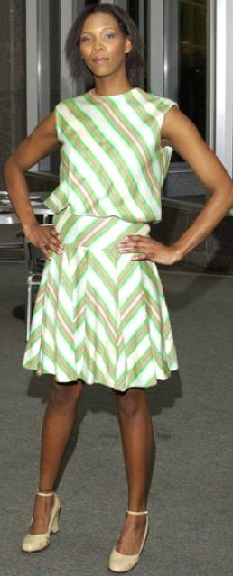
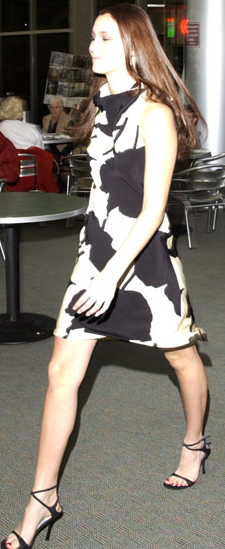
These are two of the group I designed. The photos, however, were taken in November, 2004 at my fashion show “Half-Century of Vintage Designs” by a great photographer, Ron Ranere, who also co-organizes the Boston Fashion Industry Meetup with me. It’s a great photographer who can take such good photos when models are concentrating more on moving fast for a show than on the photos. You can see more of Ron’s photos at www.positiveimage-boston.com, and learn more about the Boston Fashion Industry Meetup at http://fashion.meetup.com/1/

The dress on the left is in a four-ply pure silk crepe, and cut on the bias. The big bold black print was very 60s, as was the dress length. The unique feature was the neckline, which I call a “bib”. It was cut as a halter tying in the back, and the front was a few cowls shaped upward to form the bib shape. The dress on the right is in a 100% wool woven with gold and silver threads. The top is cut as a blouson, and the skirt is cut as a yoke skirt. The pleating was formed by tucking in an “umbrella” shape.

S.E.L.F. “Self-Employed Laboratory for Fashion

I’ve been getting a lot of requests from young designers who want both the Stylometrics Pattern System and the instructions on their use for quality, efficient, and fast pattern making. However, I am building a “research laboratory” with a few committed assistants who are self-employed in their own fashion design businesses to test further development. This takes time to make these beautiful for you with instructions for use. So, I beg your patience. I may have some beginning things after the first of the year.

We have agreed on the five primitives, and are in the process of deciding on what generic patterns we will have. Many pieces from my vintage collection will be used to explain some of those generics and how to use them. As, for example, we will have a “generic blouson”, and a “generic yoke skirt”, as developed further in the photo above. Eventually we will have a series of necklines and collars, such as a “generic cowl” neckline. If any of you have specific needs, please email me and let me know. It would help to add those needs into our plans, and you will benefit later.

Saturday, November 11, 2006

4 Successful Vintage Fashions * Join Our Live Chat


To join our “Live Chat”, with many other fashion designers and consultants from around the country (California, Texas, Florida, Maine, Massachusetts, and hopefully China) who will be there, you must click on the Fashion Product Development Meetup to find out the time and other details.
http://fashion.meetup.com/221/

The 4 fashion styles in the above photo were voted by the consumer audience as their favorites in the NEFI (New England Fashion Industry) show in November, 2004. I showed over 60 pieces from my half-century of vintage collections. Ron Ranere of Positive Images took these great photographs while the models waited to go out or while moving in the show. See: http://www.positiveimage-boston.com If any of my readers want to ask me any technical questions, I will answer them. But for now I will simply tell you about the style details and the dates.
1) The first on is from an early sixties custom collection, a royal blue silk crepe, and consists of vertical bias panels in the front and back that are basket-woven with horizontal bias panels from the hip-bone to the empire waist. You can’t see in this photo that the panels in the skirt are free to move very beautifully as you walk.

The next three are in a very soft lambskin suede, and were from my collections in the 1970s that I manufactured for many of the top designer retailers in the country. I did very well, and sold the business, when it was making a million dollars, to a men’s wear manufacturer in the 1980s.
2) A wrap coat, buttoning with one large very old button, and with raglan sleeves. This coat was enormously successful in selling because it looked flattering on a tiny petite, or a tall, heavy woman. Although there are very few I will design for today, I did repeat this one recently for my favorite customer (from the 1960’s) in a brown cashmere wool.
3) The third one was my successful suede evening gown that I talked about in a previous blog, http://fashionsolutions.blogspot.com/2006/09/my-famous-suede-evening-gown-2.html.
It was the one around which I designed a very new kind of production systems for my 25 stitchers, that made me reap a 60% profit on each, even with selling it wholesale. The gown wrapped in the back and tied in the front, and I sold it as well to some celebrities.
4) One of a collection of “landscape fashions”. The flared skirt was cut in pieces in which the aqua color represented waterways, and the beige color represented sand. You can see the bare brown tree on this side, but the other side had a series of houses. I had a girl, Toula, who had just come over from Greece, and who took these home to stitch together, the few hundred I sold. The top was a halter with a collar that wrapped in the back by brown belt ends that came to the front to be buckled.

Let me know if you have any questions. Today, I am totally committed to helping young designers.

Wednesday, November 01, 2006

My Sunburst Dress, 1962, Intricate Pattern Design


The sunburst dress was a piece in my spring collection for 1962. A proud moment was when the Boston Sunday Herald photographed it for a full page article in its Sunday Magazine, March 4, 1962. Under the photo was the following:

“SUNBURST is the name given to this new style by young Boston designer Shirley Willett. Of bright orange silk pesante, the dress is hand pleated and all the fit is within the pleating.”

It certainly goes along with today’s spring 2007 collections in which orange is a color choice of Paris fashions. A piece from the article:

“SHIRLEY WILLETT is one of Boston’s new young designers who shows an originality of design and individuality of concept that is unusual for her twenty-eight years. She is an exponent of cut and shape and believes that each garment must have something unique as well as flattering for the wearer. Shirley also feels that high fashion design warrants superior workmanship in order to be recognized as true couturier. Because of her fresh young approach we felt her styles will be of great interest to the new, young brides of 1962.”

The early 1960s was a time of extensive technical research for me, a time of intense creativity that would challenge every engineering skill I could dream up, in order to result in simplicity and the ability to reproduce easily, yet maintain the intense originality. It was a time of fashion shows, and a small but loyal group of customers, before I went into manufacturing and selling to retailers. However, because I was so devoted to research and self-learning, I made no money. But, it didn’t matter. I was a “fashion sculptress”, and supported my art in other ways. I look back at that period nostalgically. It was my kind of schooling because everything I know was self-taught. That self-teaching is what helped me to create the original technologies and educational principles that won me National Science Foundation grants in the late 1980s, after I sold my manufacturing business.

Saying the “fit is within the pleating” means that all the shaping for the bust, the waist, the hips, and in the back as well as the front – all comes into the sunburst point in the front. The way I approached the pattern then was to “slash the paper pattern” wherever I wanted the pleating to fall, and add in whatever amounts I determined. It was very complicated, a technical challenge. Today I would do it quite differently. In fact, as I tell my students and protégés, the best quality and easiest approach to complicated draping as here, is to start with my basic “dress primitive” and then drape on top of it. This is very simple explanation of something that needs a lot of visuals to help understand the principles.

Another feat I accomplished is the soft armhole. Women in the 1960s considered the armhole line hard and ugly, and did not like showing their underarms. Study the soft drape I achieved over the arm. It means the lining does the work of being a support , a different shape than the shell, in order to support the drape. Again, it would take some visuals to full grasp the technique.

I get so many questions on how to achieve some of these things that I am playing with ideas of how to do this online. What do you think? Let me know.

Friday, October 27, 2006

1960s: Hemlines and the Stock Market!


Here’s a fun post for my readers. The newsletter was sent out by Harris Upham, Inc., a stock brokerage firm, in May, 1967. My roommate at the time was working as a trader for the firm, and brought home the newsletter for me to see – since I was in the fashion industry. Hemlengths were a big fashion discussion topic in the 1960s and 1970s. Whether you believe it or not, these brokers really did believe that there was a relationship between the two. A newsletter one month later had Ralph Rotnam, a stock analyst for Harris Upham, saying that “as a barometer this chart is 100% correct.” Here is what the 1967 newsletter says:
“For some time there has been a suspicion in Wall Street that the stock market and the hemlines of women’s skirts move in the same direction. To find out if this was true we sent our textile and apparel researcher, Foy Roberson, to the library to make a detailed study. The results are shown on the chart on page one. From the days of street-sweeping skirts in 1897 to the days of Twiggy in 1967 the market is up 2100% in value. And as the chart shows the hemline changes and the direction of the market have been amazingly parallel. Perhaps we should be listening more carefully to the planning in Paris. Someone has called this a “Mini Market”. There are mini skirts, a mini recession and mini stocks.”

I used this later in the 1980s, when teaching about fashion marketing, production, and trends. I explained that a lot of fashion trends have to do with “collective social emotions”. And those affect general business, stocks, politics, etc., as well as fashion trends.

We’re getting some fashion people from other parts of the country joining us in “Fashion Product Development Meetup” on our “Live Chat”, which will be in a few days. Go to:
http://fashion.meetup.com/221/
It’s going to be a great Virtual, 21st century, Web 2.0 experience.