Showing posts with label engineering design. patterns. Show all posts

Monday, April 24, 2017

“Making It “ In Fashion Design

  After responses to our first brochure, we are sending a new brief one with photo explanations.
How Do You “Make It “ In Fashion Design?

Be a part of writing an exciting fashion design book. Designers, consumers, students and beginners (who sew), who would like to learn online free by cooperating with Shirley Willett, www.shirleywillett.com, a well- known industry expert in creative design, pattern engineering, manufacturing, and education. Her unique methods are needed to make it, have been tested over 60 years, and are easy, fun and rewarding. We start with brief and introductory Foundation Design Skills that prepare you for our methods: Inner Visualization, Manual Skills, Creativity in every step, Self-Evaluation techniques, etc. Then we go to in depth lessons: Templates that make perfect first patterns ready for production, simple Pattern manipulation techniques, methods for Draping creative styles, Truing for accuracy, and many special lessons on Bodices, Skirts, Dresses, Sleeves, Collars, Blazer, Pants, etc.
Email fashionclass@shirleywillett.com to request becoming a part of our cooperative book effort, telling us about yourself, and what you want to learn.


Friday, March 08, 2013

True Fashion Design is a Moving 3-D Sculpture


  The Boston Globe had a photo today of (above) one of the most beautiful stoneware sculpture by H. Nakashima at the Museum of Fine Arts. It prompted me to think about the beautiful 3-D curves in great fashion design. Nakashima’s sculpture has a feeling of motion in observing it, but fashion is greatest when on a moving human body.


  One of my proudest 3-D fashion sculptures is a 6-ply pure silk crepe I sold to Neiman-Marcus in 1958. (left) The cape sleeves start as a sleeve in the front, form a cape in the back and come around to the front to finish as a sleeve. It moves beautifully when moving your arms.  


  Another of my favorites that illustrates fashion as a great moving 3-D sculpture is my “Sunburst” dress, of bright orange silk pesante.(left) The accordion pleating goes all around the body and comes together in one point in the front, finishing with a sunburst pin. The pleating had an amazingly beautiful motion as the woman walked. The photo was in a full page article in the Boston Sunday Herald in 1962. It was also a favorite of my customers, who bought many of them. 

  Both of these styles required great expertise in sculpting fabric in outer space, feeling the motion in “inner visualization” – not fitting tightly to a dress form or model, as so many young designers learn to do when draping today – or when being committed to the rules of drafting. As Frank Gehry, the famous architect and jewelry designer, said, “Beauty without rules.”
 

Thursday, July 26, 2012

Boston Fashion Industry Meetup with Jay Calderin, Boston Fashion Week


The group photo was taken by Domenico, at the Boston Fashion Industry Meetup, July 24, 2012. We are the six organizers: Joseph Gualtiere, Vicky Anson, John Bilotti, , yours truly, Shirley Willett, Kathy Benharris, and Ron Ranere. If you want to know more about our meetup, go to  http://fashion.meetup.com/1/   We would love more fashion people, especially designers, to join us.

 The other photo is Jay Calderin, founder and organizer of Boston Fashion Week. He gave a great talk about all the exciting details of the week in the fall. If you want to know more about Boston Fashion Week, go to http://www.bostonfashionweek.com/

I have great news about myself. I will be the feature article in the fall issue of Boston Common Magazine. They are doing a Boston heritage issue and will talk about my involvement as Boston’s number one designer in the 1950s and 1960s, and then my suede manufacturing in the 1970s. I am not sure when the next issue comes out, either August or September. If you want to know more, go to

Saturday, February 17, 2007

Sketch Pattern Shapes That Will Make This Volley Ball


The volley ball is pictured with two views. Try “sketching” the shapes of the pattern pieces - the FEWEST PATTERN PIECES - that it takes to cut the fabric pieces for sewing together to make the ball. The 2D “shape” is what is important, and the relationship of shape to each other pattern pieces.

So many have requested my “Fashion/Pattern Design for Beginners” online, that I decided to try this first step of a class I teach at the Brookline Adult & Community Education (Boston area). This first step is a test for whether my pattern making system can be taught online.
http://www.brooklineadulted.org/bin/catalog/bldCatalogPage.pl?Key=36&File=CraftsandSkills.txt
This is a very different approach from any other pattern making book, class, online, etc. It is a non-mathematical pattern making system called Stylometrics, that I developed through National Science Foundation research grants on engineering design for the fashion industry. The purpose of my system is "to build the ability to SEE inside the mind, and for designers to CREATE solutions to their pattern problems”. Most pattern makers use math & rules, set up in books, and answer the same problems over and over again – which is OK for mass production of commodity styles, and competition between designers and pattern makers, and CAD systems – but not for creative high fashion designers. It’s what Frank Gehry, the world-famous architect, said when he began designing jewelry for Tiffiny’s: “Beauty Without Rules”. My dream is to set up STANDARDS in “Primitive & Generic Patterns” so that designers can evolve "creative high fashion styles easily" and also mass produce them easily. From what I have learned from others, I believe I had the only “mass-produced high fashion clothing manufacturing in the world” in the 60s, 70s & early 80s. Eventually those standards will involve consumers and dressmakers, so consumers will be responsible for their own "fit" (variation from the standard) with their dressmakers. It's a whole new fashion industry.

Monday, December 25, 2006

HAPPY NEW YEAR * LET’S START S.E.L.F. IN 2007


While selling my design and manufacturing business, “Shirley Willett, Inc.”, I wrote this book, “Let’s Design A Dress” and published it in 1980. There were a few reasons that I sold my business. I hated the big size that it must become if you want to maintain success, I was at the mercy of the new young 60s workers who were demanding and not like the family feeling of older stitchers and my once smaller business, and I wanted to be happy, not caught up into the making of great profits and lose my creative soul to big designer retailers. But most of all, I wanted to teach, and leave my legacy to young designers: of great styling that consumers bought and loved, and my creative and technical mastery of pattern engineering and production. I could never teach at any of the fashion schools or colleges, because with intense jealousy from teachers who could only teach what they had been taught - the old hat rules from past technical books – there would never be acceptance of creating technical systems. So, I wrote a text book that I used in the 1980s in fashion departments I set up myself at colleges or community/adult education, or with private clients in a re-incorporated, Shirley Willett, Inc., as a small business consultant. This gave me great experience with testing my innovative ideas of a new and easier methodology for pattern making – and to realize how successful the concept is.

After working on my NSF grants through the decade of the 90s, and presenting my ideas at the Massachusetts Institute of Technology in January, 2004, I again made the decision to teach and leave my legacy, successfully testing my more advanced ideas for pattern making. Now, I want to test them online for all of you, the readers of my blog, Fashion Solutions.

I created the concept of “Self-Employed Laboratory of Fashion” (SELF) with some protégés I have here locally, that are willing to help me. The most important word is Laboratory, that is we will research problems and create solutions. At this stage of a “research lab” I do not personally want a business for making money, although there will be costs. That does not apply to others working in SELF, who are each self-employed with fashion clothing businesses, or aspirations to develop one, that is not dependent on SELF for primary business income. We are going to open up the concept of SELF, for all of you that are interested in becoming a part, whether you are in a business designing for others, or just want to design and make clothes for yourself and friends. There are requirements and benefits. The great benefit is that you can get some “Primitive and Generic Patterns” (called “S-Patterns”) for a low cost, and have the ability to get your pattern problems solved free. One requirement is that in order for you to understand how to use these patterns you must study three programs of many that I designed for classes here, and give us feedback. The programs, as we are designing them for online, are necessarily different than face-to-face in a classroom. So, we are making them free, but the feedback is an imperative. Remember we are a research lab, so we need a commitment and a willingness to think about how you can help us, and help others in a system that can become worldwide, and perhaps even help the poor in developing countries eventually. And that is a really exciting legacy to be a part of.

Tomorrow I will continue this discussion with more details. I have already discussed this idea with Tracey in the U.K. and Diane in Colorado, and a few that are closer that will do it on computer. Please give me feedback now if you are interested, so that we can determine if we use the blog and my web site to present the programs, or do it with a smaller group. My protégés and I are busy preparing it for after the New Year. Continued tomorrow…

Meanwhile Happy Holidays and a Happy, Successful New Year, 2007,
Shirley

Wednesday, November 01, 2006

My Sunburst Dress, 1962, Intricate Pattern Design


The sunburst dress was a piece in my spring collection for 1962. A proud moment was when the Boston Sunday Herald photographed it for a full page article in its Sunday Magazine, March 4, 1962. Under the photo was the following:

“SUNBURST is the name given to this new style by young Boston designer Shirley Willett. Of bright orange silk pesante, the dress is hand pleated and all the fit is within the pleating.”

It certainly goes along with today’s spring 2007 collections in which orange is a color choice of Paris fashions. A piece from the article:

“SHIRLEY WILLETT is one of Boston’s new young designers who shows an originality of design and individuality of concept that is unusual for her twenty-eight years. She is an exponent of cut and shape and believes that each garment must have something unique as well as flattering for the wearer. Shirley also feels that high fashion design warrants superior workmanship in order to be recognized as true couturier. Because of her fresh young approach we felt her styles will be of great interest to the new, young brides of 1962.”

The early 1960s was a time of extensive technical research for me, a time of intense creativity that would challenge every engineering skill I could dream up, in order to result in simplicity and the ability to reproduce easily, yet maintain the intense originality. It was a time of fashion shows, and a small but loyal group of customers, before I went into manufacturing and selling to retailers. However, because I was so devoted to research and self-learning, I made no money. But, it didn’t matter. I was a “fashion sculptress”, and supported my art in other ways. I look back at that period nostalgically. It was my kind of schooling because everything I know was self-taught. That self-teaching is what helped me to create the original technologies and educational principles that won me National Science Foundation grants in the late 1980s, after I sold my manufacturing business.

Saying the “fit is within the pleating” means that all the shaping for the bust, the waist, the hips, and in the back as well as the front – all comes into the sunburst point in the front. The way I approached the pattern then was to “slash the paper pattern” wherever I wanted the pleating to fall, and add in whatever amounts I determined. It was very complicated, a technical challenge. Today I would do it quite differently. In fact, as I tell my students and protégés, the best quality and easiest approach to complicated draping as here, is to start with my basic “dress primitive” and then drape on top of it. This is very simple explanation of something that needs a lot of visuals to help understand the principles.

Another feat I accomplished is the soft armhole. Women in the 1960s considered the armhole line hard and ugly, and did not like showing their underarms. Study the soft drape I achieved over the arm. It means the lining does the work of being a support , a different shape than the shell, in order to support the drape. Again, it would take some visuals to full grasp the technique.

I get so many questions on how to achieve some of these things that I am playing with ideas of how to do this online. What do you think? Let me know.

Thursday, October 19, 2006

Bias Shaping? Answering Sarah's Request


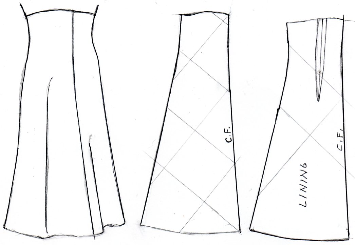
On a post a week ago, “Creative Technical Design Solutions, 1960 Bias Shape”, Sarah asked in a comment, “How do you stretch the bias? Are the skirt panels cut mirror image for symmetry?” I repeated the photo for everyone to see again. Note that the skirt of the dress I cut on the bias, and it is attached at the empire line. It is cut in four panels, a “pair” in the front, and a “pair” in the back, because the front and back, of necessity, are slightly different shaping. “Mirror image for symmetry” is a correct understanding, but we use the word “pair” in the industry. Also note that it “skims” the waist rather than revealing it, and it is an “A-Line” shape from hip bone to hem. That is, the flare of the hem is a straight line from hip bone to hem. All 3-D curvature is caused from the bias and the flare at the hem is caused by stretching the bias at the empire line.

I made three sketches to describe the process. These two words are emphasized because I want all to know this is not telling you how to make the pattern. They are rough sketches to help you see the process in your mind. The first is simply a 2D sketch of how the eyes sees 3D. So many beginners do not understand this, and call it 3D. The second sketch, please note has the same hem sweep, but is much narrower at the empire waist, and is stretched to the proper measure for matching the top. The third sketch is the lining, that has a dart to shape it. It is sewn totally free from the skirt shell. You need to develop the lining shape first, which then, on the dress form, is a base for stretching the bias of the shell in silk doupioni properly, by draping the pattern shape. Every different fabric has a different falling bias, and needs to be draped. This kind of shaping can never be accomplished flat on the table.

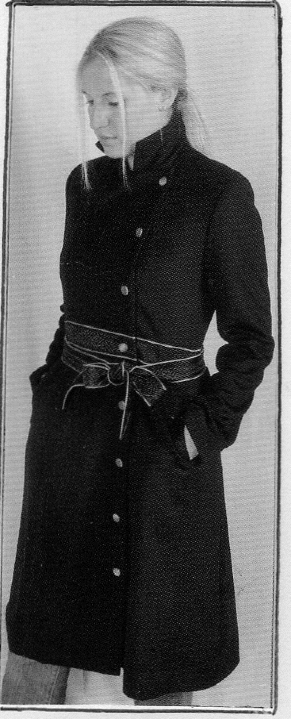
Interestingly, in one of Tess’s new shaped coats, I had her stretch the cross grain of wool at a high rise waist to accomplish something similar but much less sweep.

Let me know what you think, and if you can understand this in words. I’ve always done it by demo’s.

Tuesday, October 17, 2006

Inner Visualization of 3-D / 2-D Translations in Pattern Making


In 1980 I self-published a book, “Let’s Design A Dress”, and advertised it in Glamour Magazine. The book’s purpose was to present to young designers a new and far more efficient way to learn pattern making, especially for production. The system involved a set of nine Primitives (slopers) as a standardized base for all women’s clothing. For students, starting with a standard pattern with industry production information encoded, leaves the designer freer to create. In the late 1980’s these “primitives” became the basis of my National Science Foundation grants, and I took the book off the market.

The first graphic is a page from that book. The process of pattern making that I teach, as I taught myself as a teen, is first done by visualizing inside the mind, rather than follow a set of rules, drafting and measurements that stultify creativity. To train students to “see” in their minds, the 3D clothing style and translate to the 2D pattern pieces, I prepared various exercises. The chart of five everyday 3D objects, translated to their 2D pattern pieces, was one of those exercises. Study each one, then close your eyes, and visualize the 3D object unfolding to become the 2D pattern pieces. And then, start with the 2D pieces, close your eyes, and visualize how the pieces fold into the 3D shape. Do this over and over and its amazing how it trains the mind to begin making patterns inside, as great engineers are capable of.

About twice a year I teach a class, “Fashion/Pattern Design for Beginners” in which I use this chart, one of which I started last night. To my great surprise , the October 8th Boston Sunday Globe Magazine cover had a picture of the 5th object in the chart, a baseball unfolding. It was depicting the Red Sox falling apart. It is ideal for those that have difficulty with “spatial relations” of 3D – 2D translations.

(Note) Sarah, in a comment, asked about how I “stretched the bias” in “Creative Technical Solutions, 1960 Bias Shape”. In another day or two I will post a sketch explaining just how I did that. Remember, everyone who reads my posts, you can sign up to receive them in an email through FeedBlitz. And, I always love answering questions.

Saturday, October 14, 2006

Tess, Protégé, Producing in China


Mentoring individual designer/entrepreneurs and leaving my 57 years of expertise is my greatest satisfaction in life, especially now in my senior years. Tess, “Teresa Crowninshield”, is one of my “student/protégés”, of whom I am extremely proud. She went to China a few years ago to teach English! She couldn’t find nice clothing for herself, but she fell in love with China’s beautiful cashmere wool and silk brocades. So she went to a tailor and had him make her own ideas in these fabrics. With no formal training she sold some to others around her, and then began to bring some production lots back to Boston to sell at trunk shows and boutiques. The cashmere coat on the left, and the silk brocade jacket on the right are two examples from last year’s collection.

I met her about a year ago at the Boston Fashion Industry Meetup (see link in sidebar), for which I am Organizer. She had been doing the production for a few years utilizing beautiful trims on basic shapes, and now wanted to learn more about high fashion shape, motion and fit of coats and jackets. I took her on as a student/protégé, and she has blossomed into creating exquisite, exceptional styles, with her own unique designer identity – and with technical excellence. She worked with me about nine months, then went to China in September to produce her collection. In a telephone call a few days ago, she told me she needed to upgrade her factory in China, and is going to go bigger!! Hopefully in about a month, we may be able to see some photos of these beautiful new styles.

The important message for all the designer/entrepreneurs who read this, is how critical good communication is. I started Tess and others with a beginning study of “inner visualization” and “our standard set” of the meaning of terms so we could communicate well by phone. When she has a problem in pattern making or production, she has even called from China, and we discuss it, and solve the problem. There are some basic “principles” that I teach (never rules – as Frank Gehry, one of the world’s great architects says: “Beauty Without Rules”). In other words most technical fashion problems have the best results when creating the solution. I teach only one class as a group, “Fashion/Pattern Design for Beginners”. Learning to SEE Is the primary focus, so thereafter the class, you can learn to create your own solutions.

I am also Organizer for another fashion meetup, “Fashion Product Development Meetup” (see sidebar for link), that I am trying to figure out a way to take “virtual” and link to this Fashion Solutions blog. That is, have all the members (even around the world) meet online at a certain day and time, to discuss, and solve problems for designer/entrepreneurs. If anyone can help me with this (maybe chats?) I would really appreciate it.

Wednesday, October 11, 2006

Creative Technical Design Solutions, 1960 Bias Shaping


Many have been asking for more stories on my past creative technical solutions. When you are intensely creative then you also desire to create different ways to solve technical problems, while making the style even more beautiful in shape for the ultimate consumer. In my early collections in the late 1950s and early 1960s I did a lot of bias cuts, which I love. As I played with the bias I realzed that you could do some masterful tailoring by manipulating the bias in various ways.

Here, in this silk doupioni dress, the skirt section was bias cut, and I "stretched" the bias at the empire line seam, and the fall over the body and indenting at the waist was superbly feminine, with it's gentle waving at the hem. The top was a series of tiny box pleats, with the pleated frill a separately sewn piece. It was easy in the 50s and 60s for a young designer to get small lots of this pleating done. The model is Jo Summers, who today, owns the Copley Seven Model Agency, and owns some of my past styles. In fact, I sold this model quite well, directly to consumers from fashion shows.

If any of you want to know more about this creative technical bias cutting, please email me shirley@shirleywillett.com and I will do some diagrams to show you.

Saturday, October 07, 2006

Pattern History of Fashion Apparel Industry

The textile industry was brought to America in the 19th century from England. But the apparel industry is an American creation at the turn of the 20th century in the Greater Boston area by Jewish tailors, who engineered dressmaker patterns into patterns for mass production . Prior to their efforts, in the 19th century, garments were made individually for each woman by dressmakers who went to each woman’s home. These Jewish tailors became aware of some commonalty in the shaping, fitting and making of garments, and production pattern making was born, one pattern to fit more than one woman. They developed a mathematical sizing system to accommodate most women with very few patterns. As businessmen, interested in lowering costs, they continued developing these patterns to become paper “information systems” engineered to control quantities of exact reproductions in cutting and stitching clothing in mass production systems.


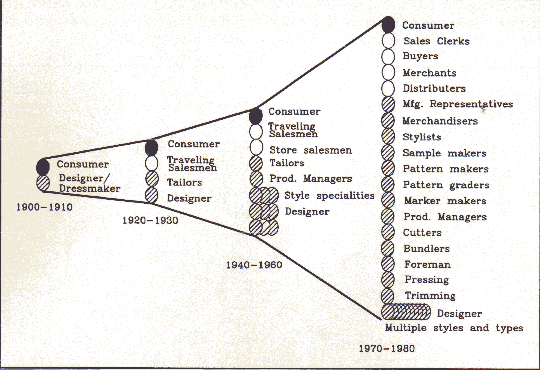
The apparel industry grew from these tailors/businessmen, as they built manufacturing factories for production, which pattern engineering accommodated. The chart above was drawn for my National Science Foundation grant report, 1991, “A 3D-4D Computerized Model for Human-Machine Integration in Apparel Manufacturing Engineering”, to show the “Fragmentation of Designer and Maker Skills, Distancing Them Further and Further from the Consumer”. Pattern engineering grew a great industry in the early and mid-20th century. But, by the end of the century, our great American apparel manufacturing industry began to fade. My personal belief is that it was much less, going south and then overseas for production, and rather these “old hat” manufacturers inability to change. They were stuck on both style and production sameness, the foundation of mass production, in order to keep costs low. As a result, they never knew, nor listened to consumers for any of their needs, and consumers are less satisfied. My grants researched ways to do “mass-produced” custom (and later “mass-customization”), computer technologies that could make consumers an integral part of a “future fashion apparel industry system”. Unfortunately, I was ahead of my time in the early 90s, and even the apparel industry’s CAD-CAM vendors, took parts of my ideas, but they too, were unwilling to change. (Perhaps I will tell some interesting stories about these vendors, later.)

Pattern making was first taught to “apprentices” who were called “designers” in the Boston area. Creative designers of styles in America didn’t exist in the early 20th century. Americans were “copyists” or interpreters of the creative ideas coming from Paris ever since the 18th century. Later some designers created booklets for teaching these systems mathematically – that came to be called “pattern drafting”. In the 1940s, when 16, I was old enough to work in these factories as a stitcher on sportswear, and met some of these pattern designers, whose information was passed to them by the old apprenticeship system. I also learned first hand about mass production systems that made America, and Boston area specifically, so famous for quality/quantity production – a system that in the second half of the century we taught to the rest of the world. (Another story later of my experiences in the 1960s that validates this.)

It was in the 1950’s, graduating from college and working in the design rooms of New York, that I learned a sad truth about fashion schools and colleges. Teachers were primarily “dressmakers” and emulated the Paris couture system – and they taught this to other teachers, becoming a narrowing circle of knowledge and experience. So, an even more extreme distancing from the consumer was taking place in the education of young designers for the industry. All workers hired in design rooms were taught in these schools, not as an apprentice in manufacturing, experience that taught critical production knowledge. I easily excelled way beyond them with a technical pattern expertise learned from my own experiments as a teenager coupled with the knowledge of stitching in production. Creators of high fashion styles today make “First Patterns”, which they spend endless time redoing for quality, but never preparing for production. While creating high fashion styles my First Patterns were “Engineered Patterns” to immediately reproduce creations into ready made garments for cost-effective manufacturing. A positive effect from these fashion schools is that America began producing more creative designers, but the negative effect is an ever widening gap between creative design and pattern engineering. (Click the “Wall Between Design and Manufacturing”) By combining great creativity with unequaled technical expertise, I became extremely successful as a designer and manufacturer of high quality designer clothing at low cost, selling nationally to all the top retailers from the 1960s to the early 1980s. . One driving point I continue to make in my grants and to students is that decisions of marketing and production, costs and quality must be made at the “Point of Design” (P.O.D., another chart I will post soon).

Friday, September 29, 2006

My Successful Chemise, 1957, Fad to Present Market Theory


In 1957, when working as a designer for a moderate dress house in Boston, I was inspired by the famous Balenciaga's "chemise" dress, and designed my own unique version with a bow on the back, for me to wear. It is a great story I have told hundreds of times since - "How fads are created, die, and sometimes reincarnated with a new name or form."

Before 1957, the only mass market styles that had sold for a couple of decades were all based on the "shirt-maker dress", with a tightly belted waist. When Balenciaga, Paris, designed the chemise (a term from 1920s of a straight hanging dress) I fell in love with it, and designed a version for myself. My boss was intrigued, and suggested I design one for our line of moderate-priced dresses - $11.75 wholesale, $22 retail. The one in the photo is an exact replica I did for a recent fashion show.

We sent it to the New York showroom, where buyers laughed at it, so it was put on a rack to come back to Boston. A buyer from J. L. Hudson's in Detroit saw it, and exclaimed: "Is this a chemise? I'll buy it for an ad – if you cut it." We put it back on the line, and sold very few, about 200. We decided to cut it – just to order - that is, not cutting the many extras to prepare for reorders. When it hit the stores – it astounded us all – it sold out so fast, and reordered so many tmes that we were completely producing only chemise dresses for two years. SECONDS IN TIMING AND I WOULDN'T HAVE HAD THIS GREAT SUCCESS - THE 2nd HOTTEST CHEMISE DRESS IN THE MARKET.

THE FAD:
After two years, the chemise died. It took research and time to discover why. Every buyer said don't even mention the name chemise. "We're stuck with a whole bunch of them in inventory. Fortunately for us, our chemise dress sold out, but the "bad ones" were like bad apples and poisoned ours as well. Why were they bad? Most dress manufacturers saw the chemise as a "golden apple", took their shirtmaker dress patterns, let out the darts and let them "hang". They were horrible on the body. Ours was beautiful because I had "shaped" the chemise as a beautiful form, emulating Balenciaga's great sculpture in my unique styling. FADS DIE BECAUSE EVERYONE GETS IN ON THEM AND FLOODS THE MARKET WITH POOR VERSIONS.

REINCARNATION:
It was years later that I began noticing the chemise in stores again, but never called the chemise. It was now called the SHIFT. It sells to this day as the shift dress, and has become a commodity item for women's house dresses, and occasionally higher styling. Interestingly, as I monitor technology as well as fashion, I saw a similar event replicated in robots, and more recently in the "dot,coms". It all comes down to "quality". When everyone gets into a big selling item and makes it, and does it, poorly, the item dies, and it's called a fad. But, those that continue to do it right, or study how to do it right, reincarnate the item, but it always becomes quieter, without any market hype. That is happening with robotics, and the dot,coms, today. In my engineering design papers I explain this as my "Chemise Theory". It's a fun story, and I've told it at many seminars.

Please, readers, let me know some comments, even if it's just to tell me you read it. Then I'll keep the stories coming. I have many to tell. Thanks