Showing posts with label shaping. Show all posts

Friday, March 08, 2013

True Fashion Design is a Moving 3-D Sculpture


  The Boston Globe had a photo today of (above) one of the most beautiful stoneware sculpture by H. Nakashima at the Museum of Fine Arts. It prompted me to think about the beautiful 3-D curves in great fashion design. Nakashima’s sculpture has a feeling of motion in observing it, but fashion is greatest when on a moving human body.


  One of my proudest 3-D fashion sculptures is a 6-ply pure silk crepe I sold to Neiman-Marcus in 1958. (left) The cape sleeves start as a sleeve in the front, form a cape in the back and come around to the front to finish as a sleeve. It moves beautifully when moving your arms.  


  Another of my favorites that illustrates fashion as a great moving 3-D sculpture is my “Sunburst” dress, of bright orange silk pesante.(left) The accordion pleating goes all around the body and comes together in one point in the front, finishing with a sunburst pin. The pleating had an amazingly beautiful motion as the woman walked. The photo was in a full page article in the Boston Sunday Herald in 1962. It was also a favorite of my customers, who bought many of them. 

  Both of these styles required great expertise in sculpting fabric in outer space, feeling the motion in “inner visualization” – not fitting tightly to a dress form or model, as so many young designers learn to do when draping today – or when being committed to the rules of drafting. As Frank Gehry, the famous architect and jewelry designer, said, “Beauty without rules.”
 

Thursday, October 19, 2006

Bias Shaping? Answering Sarah's Request


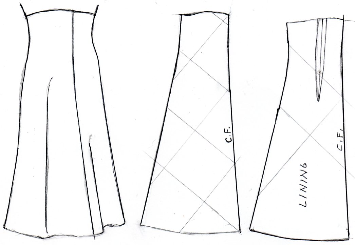
On a post a week ago, “Creative Technical Design Solutions, 1960 Bias Shape”, Sarah asked in a comment, “How do you stretch the bias? Are the skirt panels cut mirror image for symmetry?” I repeated the photo for everyone to see again. Note that the skirt of the dress I cut on the bias, and it is attached at the empire line. It is cut in four panels, a “pair” in the front, and a “pair” in the back, because the front and back, of necessity, are slightly different shaping. “Mirror image for symmetry” is a correct understanding, but we use the word “pair” in the industry. Also note that it “skims” the waist rather than revealing it, and it is an “A-Line” shape from hip bone to hem. That is, the flare of the hem is a straight line from hip bone to hem. All 3-D curvature is caused from the bias and the flare at the hem is caused by stretching the bias at the empire line.

I made three sketches to describe the process. These two words are emphasized because I want all to know this is not telling you how to make the pattern. They are rough sketches to help you see the process in your mind. The first is simply a 2D sketch of how the eyes sees 3D. So many beginners do not understand this, and call it 3D. The second sketch, please note has the same hem sweep, but is much narrower at the empire waist, and is stretched to the proper measure for matching the top. The third sketch is the lining, that has a dart to shape it. It is sewn totally free from the skirt shell. You need to develop the lining shape first, which then, on the dress form, is a base for stretching the bias of the shell in silk doupioni properly, by draping the pattern shape. Every different fabric has a different falling bias, and needs to be draped. This kind of shaping can never be accomplished flat on the table.

Interestingly, in one of Tess’s new shaped coats, I had her stretch the cross grain of wool at a high rise waist to accomplish something similar but much less sweep.

Let me know what you think, and if you can understand this in words. I’ve always done it by demo’s.