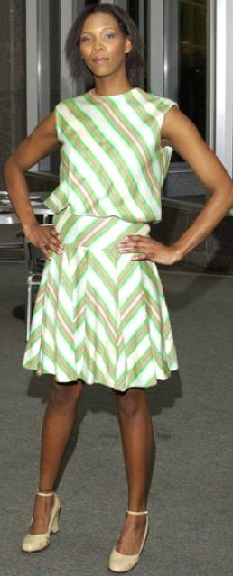
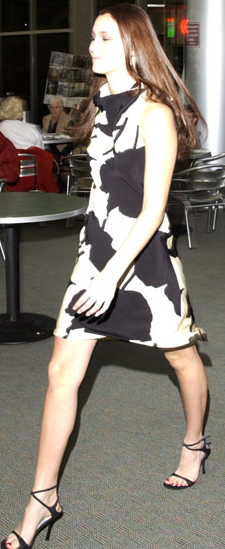
Sunday, October 28, 2007

Draping a Dress from Stylometrics Pattern Template


The blue and white silk crepe dress is on me when I received a "Boston Fashion Week Ladder Award" sponsored by the Fashion Group International in September. It was for all my work to help young fashion entrepreneurs up the "ladder". The photo was tajen when I received a unique bouquet of roses from my fashion protégés at our Boston Design Lab fashion show.

In a post on 12.26.2006, "Drape Dress" I showed the design for this dress, and the AB-1 Empire Template on which the dress was draped. I added the big bow. All the darts and the empire line was transformed into draping, which is something I love to do. By draping from a Template the dress maintains a "standard" of sizing and shaping,the lack of which is a significant problem that consumers face, especially with haute couture from around the world.

I love comments and questions. If you have any about this process I will reply.

Sunday, October 21, 2007

Boston Design Lab Fashion Show


First, I apologize for such a long time since my last post. But I am now going to be doing many posts, lots of photos from my fashion show, "Boston Design Lab" at the Hotel Commonwealth during Boston Fashion Week in September. These are two photos by Ron Ranere, Positive Image. You can see many more on his web site,http://www.positiveimage-boston.com/bdlweb/index.htm
There are also more photos on BostonFashion.com at http://www.bostonfashion.com/directory/bostondesignlab.html

I will be getting up more this week, and will work out the problem of leaving comments. Thanks for your patience.

Saturday, February 17, 2007

Sketch Pattern Shapes That Will Make This Volley Ball


The volley ball is pictured with two views. Try “sketching” the shapes of the pattern pieces - the FEWEST PATTERN PIECES - that it takes to cut the fabric pieces for sewing together to make the ball. The 2D “shape” is what is important, and the relationship of shape to each other pattern pieces.

So many have requested my “Fashion/Pattern Design for Beginners” online, that I decided to try this first step of a class I teach at the Brookline Adult & Community Education (Boston area). This first step is a test for whether my pattern making system can be taught online.
http://www.brooklineadulted.org/bin/catalog/bldCatalogPage.pl?Key=36&File=CraftsandSkills.txt
This is a very different approach from any other pattern making book, class, online, etc. It is a non-mathematical pattern making system called Stylometrics, that I developed through National Science Foundation research grants on engineering design for the fashion industry. The purpose of my system is "to build the ability to SEE inside the mind, and for designers to CREATE solutions to their pattern problems”. Most pattern makers use math & rules, set up in books, and answer the same problems over and over again – which is OK for mass production of commodity styles, and competition between designers and pattern makers, and CAD systems – but not for creative high fashion designers. It’s what Frank Gehry, the world-famous architect, said when he began designing jewelry for Tiffiny’s: “Beauty Without Rules”. My dream is to set up STANDARDS in “Primitive & Generic Patterns” so that designers can evolve "creative high fashion styles easily" and also mass produce them easily. From what I have learned from others, I believe I had the only “mass-produced high fashion clothing manufacturing in the world” in the 60s, 70s & early 80s. Eventually those standards will involve consumers and dressmakers, so consumers will be responsible for their own "fit" (variation from the standard) with their dressmakers. It's a whole new fashion industry.

The Pattern Shapes for Cutting and Making the Volley Ball


Here’s the pattern shapes. How did you do? Go back and forth between the pictures of the ball and the pattern pieces. The “fewest pattern pieces” are 2. First note that there are six sections of 3 cut pieces that are alike. Then note that there is one center piece of that 3-pc. section. That is the one pattern piece pictured that says “Cut 6”. With further study you will see that the pattern pieces on either side of the center one are alike in shape, but, like our hands, are left and right. Just as we call a PAIR of gloves for the hands, we can use the same pattern piece for the left and right, by cutting a PAIR. There are 6 pair of this piece for the ball. So, the conclusion is that the “fewest pattern pieces are 2.” Please comment or email me about how you did, and what you think of this exercise.

Judging from some responses to an earlier post, and the difficulty in what must be expressed in words for online, I cannot set up any kind of online teaching of my unique pattern making process, Stylometrics. I will be continuing to answer the many wonderful questions I get from these posts. So, keep your questions and comments coming.

Saturday, January 27, 2007

Cathy Horne, NYT & Creative Technological Solutions


Cathy Horne, the fashion editor of the New York Times, has started a blog. Her articles are excellent, especially about the Haute Couture. I was so impressed by her blog post today, that I made a comment. Please go to the blog and be sure to click on the Digital Flipbook at the end of her blog, and you will see an entire collection of steps that Alber Elbaz, the designer at Lanvin, went through to create a technological solution to a problem. The two photos here are from that Flipbook. You can see the post at http://runway.blogs.nytimes.com/?th&emc=th

The title of her blog today, is HOWJADOTHAT? She starts: "From time to time on this blog, I’d like to show you how something is done, in the hopes of better explaining the creative process. Not long ago in New York, over lunch with the now-pinned Alber Elbaz, we got to talking about the trouble with futurism. At the spring 07 shows in Milan and Paris, futurism was suddenly the buzz word. But, as Elbaz pointed out, tomorrow is actually a difficult place to reach. ... He asked an Italian mill to produce a fabric that was 100 percent polyester. Yet, as modern as the fabric looked, the seamstresses at Lanvin had trouble sewing it. “I thought, ‘Wow, this is amazing — a fabric that rejects pins,’.” Elbaz said. “Some fabrics are very stubborn. They don’t want to be told what to do.” Nothing worked at first. “We tried using elastic. Too Adidas. We tried using jewels. Too cheap-looking. You start questioning yourself.” Eventually Elbaz found that if he basted silk organza underneath the polyester, he could get the voluptuous shape he wanted. “It really challenged me,” he said. “You want to give up and you want to win.”

MY COMMENT (They printed it on the NYT blog)
Thank you, Cathy Horne. I have always loved your articles because you are not afraid to "shoot from the hip" when necessary about the haute couture. Your blog, again, shows what is necessary to be said. To reveal what "technological" work some designers go through in their research and experimentation is so needed by the young and often foolishly romantic designer entrepreneurs and fashion school students - who worship the ridiculous Project Runway as their ideal.

After almost 60 years in the fashion industry as a designer & manufacturer of high fashion, and winning engineering design grants for the fashion industry, I know well what it is like to spend effort on creative technological solutions like Alber Elbaz on lining polyester with silk organza to achieve the desired result. Today, as a mentor for the very few young designers who can achieve something worthwhile for the future, I motivate them toward excellence in researching technology to compliment great creative ideas.

Thursday, January 25, 2007

Fashion Future: Crafts, Consumer/Designers & SELF


The new postal stamps, with “Quilts from Gee’s Bend” are very inspirational and timed well to what I see as an extremely important development in the fashion industry for DEs (Designer Entrepreneurs) and consumers. For those who are very creative, and love to play with art, graphics and colors in fashion, the spring/summer season is great for experimentation, especially for those DEs that sell directly to consumers. The sleeveless jacket and skirt is one from the 1980s of my huge vintage collection. The photo is by Ron Ranere, Positive Image, http://www.positiveimage-boston.com. It is in Ivory colored leather with the leaf patterns (front & back) in different colors of lambskin suede. It could sell very well this year, but I’m not selling anymore. I simply want to inspire you. Can’t you see using some of those color combinations or even some patterns of the quilts as appliqués or pieces of the garment shape in a dress, skirt or top?

I have been very busy helping DEs locally in Boston. As you well know, I am organizer for the Boston Fashion Industry Meetup, for all aspects of the industry to help one another, by meeting face to face locally. http://fashion.meetup.com/1/ You also know that I organize the Fashion Product Development Meetup, that is now completely virtual, online for CHAT discussions. I make announcements on this web site for when I will be online to talk. You can join (anyone, anywhere & free) and then learn when. http://fashion.meetup.com/221/ I now have just added a third meetup, Boston Craft & Fashion Sellers Meetup. Ivy Glass is my assistant organizer, and we hold the meetups at her studio in the artists spaces at Fort Point. It’s purpose is to research all the craft shows, fashion shows for DEs, and set up some as well as trunk shows and home parties in New England – all for selling direct to consumers, that helps you to make an income. If you go to the web site, you will see the same photo of my leather outfit with the leaf patterns. Click: http://craftsellers.meetup.com/76/ We will be having our first meetup Feb. 8. I’m telling all of you about it because eventually, once we get it well established here, those of you in other parts of the country could also set up a Craft Sellers Meetup (and I will help you). Then, we could even exchange products and help each other sell over all parts of the country. Wouldn’t it be great to have that kind of “organized selling power”?

There’s some other things that keep me very busy as well, all for helping young DEs. I am a business consultant for the Center for Women & Enterprise (CWE) in New England. They have the best and cheapest business advice and classes. If any of you are in this area, you should check them out. http://www.cweonline.org I just met one of their clients that is really interesting, and represents the wave of the future in fabric coloring. She has been doing customized fabric dying for chains like the Gap, Ann Taylor, etc., and now is going big. Everyone is interested world-wide because she has established STANDARDS for fabric coloring, globally, and will be having it digitally as well. In my talk with her, she knows that the future is for consumers, and small businesses on the web, and eventually will have something for you as well. I will keep you posted. Go see her web site. http://www.precisiontex.com/index.php

All the work in SELF (Self-Employed Laboratory of Fashion) keeps mounting, because the group of members are all each making a tiny collection of dresses for spring/summer that are based on my Generic S-Patterns, both to test them and to help the members develop their styles. There is a great deal of graphics and craft influence in what we do. Unfortunately for you, this is completely local. We are having a meeting on the 3rd. and will keep you updated on what we set up. We also have one member that I’m helping to set up a business for sourcing cottons and silks from India. Once some of these things are set up then we can offer it to you as well.

By now you must realize that I do not have the time to set up an online teaching structure for learning about the S-Patterns. I’m sorry that some of you had hopes of this. Maybe I will meet someone in the local area that I will teach and she or he could do it?

If any have questions, please ask me. I love to answer them. My commitment is to help young DEs for a very interesting 21st century future.

Sunday, January 14, 2007

YOU, Time Person of the Year, SELF & S-Patterns

I have been asked about the difference between SELF and S Patterns. SELF (Self-Employed Laboratory of Fashion) is fundamentally a Laboratory doing Research & Development (R&D), and is a non-financial entity. That is, each within it has a self-employed business outside of SELF. But, we work together within SELF, creating, researching, developing new ideas and solve problems in creating fashions, engineering patterns for production, and marketing & selling. SELF is not an entity that sells anything itself. Rather, the resulting products like the S Patterns, are sold through individual self-employed businesses, who are working together in SELF. Right now we have six of as potentially researching some aspect of the fashion industry. In other words, big corporate retailers & manufacturers have their important R&D departments. YOU, tiny DEs, have us. It is very exciting to be creating a 21st century new fashion industry for YOU. We have ideas for business structures, technologies, marketing, sales, etc.

The choice of the 2006 Time Person of the Year says it all. It’s YOU. Gerry McGovern, who is the best consultant on the web, about the web, wrote the following in his blog, which I totally agree with about the future for all industries as well as the fashion industry, YOU & the web. http://www.gerrymcgovern.com
“The Web has become the organization. An organization of a billion people with a billion things to say. And a million ways to work together. … The Web allows for new forms of organization that will have a profound impact on how we live, work and play over the next twenty years. Traditionally, the tools of organization belonged to a powerful elite. … Today, your office can be at Starbucks, while your network is wireless. You can get a complicated job delivered to the highest standards without any fulltime employees; just your network of independent partners who agree to work towards a shared objective. This is a new way of working. This is different. [This is also SELF] … This organization of you, me and us doesn't need to listen to the old organizations as much any more. We don't need to be told what is cool by some fashion guru, or some clever ad campaign. We decide. … "A person like me" is more trusted than doctors, academics and other such experts. In the U.S., trust in "a person like me" has shown a dramatic increase from just 20 percent in 2003 to 68 percent in 2006. … Those organizations that do not become truly customer-centric will be severely punished by the Web. … This is the age of customer power, customer collaboration, customer content; the sprawling, highly networked organization of YOU. “

Tuesday, January 09, 2007

S-PATTERNS Will Be a Part of the Future Technology Wave


First, I must apologize to all those to whom I said the 3 “Fashion/Pattern Design” classes for understanding how to work with the S-Patterns would be online by this past weekend. I’m sorry but it is going to longer to get it set up for the web. At this point we’re not sure, but maybe another week or two. Meanwhile we are continuing to develop the Primitive and Generic Patterns so they will be available for delivering to you.

(From the Boston Globe: "A modified iRobot Create can pick up a piece of paper. iRobot, unlike the Roomba, does not vacuum or clean.)

My “Chemise Theory” and Robotics today
Some of you, who have read my posts last September, might remember the one I wrote about my successful “chemise dress” I designed in 1957. (Click September in right column if you want to read the whole story.) The chemise was a fad, died and then was reincarnated as the “shift”, and has been a successful seller ever since for high fashion or commodity designers. Even more interesting is that the chemise is having a great high fashion comeback for spring, 2007. In all of my engineering design papers, related to my NSF research grants, I explained the story of the chemise dress, and used it as a social theory to explain how most fads rise, die, and come back again as more ubiquitous and not faddish. The primary example for which I used the chemise as analogy in the late 1980s was robotics, and I predicted its comeback. That is, robotics, at that time, was a “fad”, big in the media and everyone talked of the great things it would do for people at home. Robotics then died in the public eye, only being considered in robotic arms on factory floors.

For awhile I have been watching robotics making a slow comeback into importance, as I predicted, as the Roomba, vacuum cleaner. Now, it’s evolving. In yesterday’s Boston Globe, 1.8.07, “Technology clears a path for putting robots to work … emphasis is beginning to shift away from robots that entertain and towards robots that labor in the home and the office.” But, the most exciting and key aspect is the “development of a common platform like Create or Microsoft Robotics Studio that will allow hobbyists, students, and entrepreneurs to play around with creating robots without having to become an expert in every aspect of robotics. …software that allow people to use their products as a starting point to create something of their own….build on top of it and go further. …after finding that robot hobbyists were trying to customize the Roomba.”

S-Patterns as a common, foundation, platform.
This is precisely what I am trying to do with the technology idea of S-Patterns. The purpose of the original Stylometrics system, in the 80s & early 90s NSF research grants, was to be a “common platform” for the American apparel industry. They would not accept it, as Sears Roebuck and the Dept of Defense had also tried to do, for 20 years previously. So, in 2004, after my workshop at MIT, I decided to take Stylometrics, my “common platform” for pattern engineering, to you, Designer/Entrepreneurs (DEs) and to consumers. It’s purpose, likewise, is to allow you to play around with creating high fashion clothing without having to become an expert in every aspect of the fashion industry.

In my nine Primitives for NSF research grants, I validated that they could be a common platform in women’s wear, for every style that ever was, is, or could be. The Generic Patterns that we are now developing are an “evolution” of those Primitives, necessary for making the system simpler for developing some more complex styles. As we go in SELF (Self-Employed Laboratory of Fashion) we will develop more complex shapes, to gradually make more styles easier for you. However, please realize that all of this will take time. I no longer have any grant funding, and don’t want a business that makes money. But I do have some devoted people, self-employed, working with me to help, and I am deeply appreciative of that. Eventually (much later) we will set up what I call “FitAWear” standards, to simply changing patterns to fit some common problems. We even have “StyleAWear” and others under the umbrella of “SelfAWear” coming over time – all for you.

When we say a “common platform” or “standardization”, that means that every pattern style evolves from the foundation Primitives. You will note in the 12.9.06 post “More on SELF…” I showed the sheath dress sketch, or AB Primitive. Next to it I showed the sketch of an empire waist sheath, or AB-1 Generic. Size and measurements of the two are identical. The jewel neckline, sleeve, armhole are identical. The only difference is the waist and midriff, which is not as simple as it seems at first glance, because the empire waist indents under the bust more, and therefore also needs more length under the bust. After we have more generic dresses, tops, skirts, blazer, etc., we will also have generic necklines, collars, sleeves, etc. Later we will do pants. And even much later we will do some foundation construction technologies. All this for you at low cost, and some things will be free.

I’ll keep you updated as we get things ready. Happy New 2007!

Thursday, December 28, 2006

S-Patterns and SELF (Self-Employed Laboratory of Fashion)


As an important reminder I will mention about S.E.L.F. structure on each blog post, that we are a Laboratory for research and solving problems in couture and high fashion design and production – for DEs and consumers all over the world – because you are the ones that need our help, and to whom I am committed. The same solutions can be used in lower priced apparel and big name manufacturers, but it is the high fashion market that desperately needs to learn quality yet also cost-effective ways of producing.I could give you many examples of bad shape/fit and poor workmanship on shape/fit on $2000 and up brand label apparel. But, if you truly want to sell and you’re not a “brand label”, then consider trying out our “S-Pattern” system. Yesterday’s blog post gave you a little on the S-Patterns for developing a fashion style. And in order to get these patterns you must learn first how to use them – in 3 learning lessons.

By January 6, 2007, we will have the first lesson on the web for you to do. You must email me of your interest to get the URL in an email reply.
1) The first lesson is about learning to SEE inside your mind, the 2-D & 3-D translations, which is what creative pattern making is all about. That is my Stylometrics system which I spent years researching with grants from the National Science Foundation, and is a non-mathematical system. You must have experience in sewing clothing to comprehend the system. Hopefully you have the ability to send me some sketches of shapes you draw by email. If not, then you can send by regular mail.
2) The second lesson is the experience of manipulating a primitive pattern to a new shape, still a creative, observing methodology.
3) The third lesson is the experience of adding seam allowances in such a way that an industrial stitcher can make the style cost-effectively.

Some have been asking me questions, such as learning ways to get better fitting. This is way down the road, and there are many new things to learn first about a new system. “First things first” and “One step at a time”, are some philosophies to guide you. Remember that the S-Patterns are “standards”, that are used to evolve all styles, shapes, and fit from. It’s the key by which we can help you with every pattern evolved from it. I’ve had a university in Singapore quote and praise the concept in the mid-1990s. A CAD vendor in Germany in 2001 contacted me about using the Stylometrics system. We emailed back and forth, until I realized he wanted me to design a way to put my system on top of his CAD system. I said no way, being a “standard”, he had to design a way to put his CAD system on top of my pattern system. We failed to agree, and I now realize that it’s best to teach it to the young DEs and consumers, and forget old hat CAD vendors & apparel manufacturers.

Please email me and let me know your interest, so that as soon as the URL is ready I will send it to you. Meanwhile, have a Happy & Successful New 2007. Shirley

Tuesday, December 26, 2006

Generic S-Pattern & Developing a Dress Style Idea


On 12.9.06 I showed you the Generic Empire Sheath, which we are now calling “AB-1”, and is shown again here on the right. “AB” is the title of the basic sheath dress as a combination of A Bodice and B Sheath skirt. I just designed the draped dress, sketched on the left, and it will be developed from the Generic Empire Sheath Dress, or AB-1. The new style has draping that takes the place of darts, something I love to do. By developing it from the generic, the dress will maintain a “standard” of sizing and shaping, which is an imperative for those who are repeating a style for customers. The new style is a “simulated wrap”. That is, the piece diagonally crossing over the front covers the side zipper and is attached after putting the dress on. There are some complexities, but they are in the “construction”, not in the development of the pattern shape. As we are developing the many generic patterns for DEs (Designer/Entrepreneurs), we are also going to develop a small collection for spring/summer that will test these generics, and will be sold to consumers. Not only can DEs buy the generic patterns, but they can also buy the patterns for the styles we develop.

I know I said I would give you more on setting up for beginning instructions on S-Patterns. But, this was all I could get done today. I will continue tomorrow.

Monday, December 25, 2006

HAPPY NEW YEAR * LET’S START S.E.L.F. IN 2007


While selling my design and manufacturing business, “Shirley Willett, Inc.”, I wrote this book, “Let’s Design A Dress” and published it in 1980. There were a few reasons that I sold my business. I hated the big size that it must become if you want to maintain success, I was at the mercy of the new young 60s workers who were demanding and not like the family feeling of older stitchers and my once smaller business, and I wanted to be happy, not caught up into the making of great profits and lose my creative soul to big designer retailers. But most of all, I wanted to teach, and leave my legacy to young designers: of great styling that consumers bought and loved, and my creative and technical mastery of pattern engineering and production. I could never teach at any of the fashion schools or colleges, because with intense jealousy from teachers who could only teach what they had been taught - the old hat rules from past technical books – there would never be acceptance of creating technical systems. So, I wrote a text book that I used in the 1980s in fashion departments I set up myself at colleges or community/adult education, or with private clients in a re-incorporated, Shirley Willett, Inc., as a small business consultant. This gave me great experience with testing my innovative ideas of a new and easier methodology for pattern making – and to realize how successful the concept is.

After working on my NSF grants through the decade of the 90s, and presenting my ideas at the Massachusetts Institute of Technology in January, 2004, I again made the decision to teach and leave my legacy, successfully testing my more advanced ideas for pattern making. Now, I want to test them online for all of you, the readers of my blog, Fashion Solutions.

I created the concept of “Self-Employed Laboratory of Fashion” (SELF) with some protégés I have here locally, that are willing to help me. The most important word is Laboratory, that is we will research problems and create solutions. At this stage of a “research lab” I do not personally want a business for making money, although there will be costs. That does not apply to others working in SELF, who are each self-employed with fashion clothing businesses, or aspirations to develop one, that is not dependent on SELF for primary business income. We are going to open up the concept of SELF, for all of you that are interested in becoming a part, whether you are in a business designing for others, or just want to design and make clothes for yourself and friends. There are requirements and benefits. The great benefit is that you can get some “Primitive and Generic Patterns” (called “S-Patterns”) for a low cost, and have the ability to get your pattern problems solved free. One requirement is that in order for you to understand how to use these patterns you must study three programs of many that I designed for classes here, and give us feedback. The programs, as we are designing them for online, are necessarily different than face-to-face in a classroom. So, we are making them free, but the feedback is an imperative. Remember we are a research lab, so we need a commitment and a willingness to think about how you can help us, and help others in a system that can become worldwide, and perhaps even help the poor in developing countries eventually. And that is a really exciting legacy to be a part of.

Tomorrow I will continue this discussion with more details. I have already discussed this idea with Tracey in the U.K. and Diane in Colorado, and a few that are closer that will do it on computer. Please give me feedback now if you are interested, so that we can determine if we use the blog and my web site to present the programs, or do it with a smaller group. My protégés and I are busy preparing it for after the New Year. Continued tomorrow…

Meanwhile Happy Holidays and a Happy, Successful New Year, 2007,
Shirley

Saturday, December 16, 2006

1968 Ball Coat - Inspiration, Apollo Mission


In 1968 I was inspired by the Apollo Mission, the first time astronauts went around the moon. The moon as a ball was the inspirational 3-D shape. The outside shell was in a heavy worsted wool, cut into spherical slices for shaping as a ball, much like we do with the global ball of the earth – and with slit openings as in a cape. The inside lining was silk taffeta, with a very 60’s graphic pattern of balls. The lining was fully interlined with lambs wool and cut as a coat with sleeves. The part of the sleeve that came out from the slit was covered in the shell fabric of worsted wool. I designed the helmet in white mink fur in 1968 to go with the coat.

In 1968 I was the chair of the fashion dept. of Massachusetts College of Art, and had no time to do a whole collection. I was frustrated, so that when I did design it had to be very expressive of my creative sculptural abilities, with less consideration for the fashion consumer, or its salability. Although I wore it a great deal myself, and when I did I got the most attention from young adolescent girls!

The boots are actually just “boot-tops” that I designed for a vintage fashion show of my styles in November, 2004. I created and made a few of them in different colored leathers, to go over shoes. It’s a very inexpensive way to have a wardrobe of boots, as no one knows they aren’t actually boots.

The photographs were done by Ron Ranere, Positive Image Studios.
http://www.positiveimage-boston.com
The model is Lidiya Lovkh lovikhl@yahoo.com

Everyone, Happy Holidays
Shirley

Saturday, December 09, 2006

More on S.E.L.F * Standards * Prepare for CHAT


Many of you are asking to learn more about SELF and the S-Patterns, or Stylometrics system. Here’s a very simple example, even though they are not ready yet for you to buy and use. In the Nov. 18th post, “SELF (Self-Employed Laboratory of Fashion) Coming” I diagrammed five of the nine “Primitive Patterns” that were designed and researched in my grants on Stylometrics, and that I said would be a base for the S-Patterns – P-1 Bodice, P-8 Skirt (as a dress in first sketch); P-2 Blazer, P-7 Pants (in second sketch); and P-9, Gored Skirt (in third sketch). The first sketch above is now a dress pattern I am calling AB Primitive. Note that it includes the sleeve accurately related to the bodice, and all pieces are planned to match perfectly. The second sketch is a generic evolution I am calling AB-1 Generic. The critical plan to make the system easy and excellent quality for everyone is that each generic will have just the key style as changes in the pattern. That is, note that the all over 3-D shape is almost the same except for the indent under the bust, and the jewel neckline, sleeves, sheath skirt are identical. This is very important for the ease in pattern making. There will be hundreds of generic patterns as we evolve them from all the primitives, including necklines, collars and sleeves.

What makes the Stylometrics system work is that the Primitive Patterns are standards, that is the #6 definition in the dictionary, “a structure built for or serving as a base or support”. The Generic Patterns will all evolve from the primitives, and you will need to evolve your personal styles from the primitives or the generics. I will not evolve the patterns for you, although there may be some technical designers connected to SELF eventually that may do that for you. I will do some instruction, but I’m trying to keep it simple. One thing to realize that this system takes an ability to see creatively in spatial dimensions inside the mind. That’s why I wrote the Oct 17th post, “Inner Visualization of 3-D / 2-D Translations in Pattern Making”. Please look at it again, and ask me questions if you don’t understand it. I am experimenting with a couple of designers online to see if they can understand this basic principle. That is this system is not drafting at all. If you study the photo of the blue silk dress with panels interwoven at the waist, (See Nov. 11th post, “4 Successful Vintage Fashions”) you will see that it can be evolved from the AB-1 Generic, with an empire waist. (Note, the photo was by Ron Ranere, Positive Images, www.positiveimage-boston.com ) But, it does require for you to “design”, “drape” and “see in your mind to develop further. It’s interesting that Georgene, designing for 25 years, says she “prefers draping to drafting”. Drafting is very old hat and belongs in the cheap commodity trade. But draping can be difficult to get a pattern for reproduction for more of the same styles. I’m trying to set up a system that still requires you to drape your ideas, but evolved from a standard so you will have the result reproducible.

I hope all of you will join our CHAT tomorrow, so we can discuss this further, and I can answer any questions. Remember you must go to Fashion Product Development Meetup and RSVP Yes, so that I know you are coming. I will cut anyone I don’t know from joining us.
http://fashion.meetup.com/221/

Saturday, December 02, 2006

S-Patterns & SELF (Self-Employed Laboratory for Fashion)


Logo for
S Patterns
represents
fashion, & S
for S-ELF,
S-tylometrics
& S-hirley


STANDARDIZING PATTERNS
In my grant research work for NSF, an objective was to test the Stylometrics Primitive Patterns as standard templates for the whole American apparel industry. The graphic is an example of that testing. The dotted lines show the side view and 2D pattern pieces of the Stylometrics Pants Primitive compared with an Ann Klein pair of pants in solid lines - the same size, but Ann Klein’s was shaped for a model’s “stance”, while our Primitive was shaped for the average woman. The objective was that it would not matter if every manufacturer wanted a different shape, because the computer software I was designing could calculate the differences and match the appropriate one to “consumer profiles” to be established. The graphic was copied from the workshop paper for MIT that you can see at my web site. http://www.shirleywillett.com


There’s been many requests from around the world for me to help in quality pattern making and to answer problems that both my Stylometrics Pattern system and SELF is being designed to answer. Because I want this innovative system to be an excellent one and to be a legacy of my nearly 60 years of experience, expertise and knowledge of the fashion clothing industry, it must be carefully researched and developed. That’s why I call it a research LABORATORY. Please be patient – it takes time to be excellent. But it also takes knowing your needs and problems – so please keep letting me know more about your work.

Some history is necessary to understand the changes in direction for the use of the Stylometrics system over the past 20 years, and why it is taking time to develop it for you. That is, the original series of research grants that I won from the National Science Foundation, starting in 1989, were for helping the American apparel industry and their CAD/CAM vendors, completely different goals than for young designers and consumers. The graphic of the pants comparison is just one of many tests done for applying the system to the industry and trying to promote the tremendous need for standards. Unfortunately, I learned when working with NIST (National Institute for Standards & Technology) and Natick Army Labs, that Sears & Roebuck and the Dept. of Defense had spent 20 years pushing American apparel manufacturers to accept standards in just sizing. Each one said, ”Sure, but use mine. I’m not changing my sizes to anyone else’s” Even my innovation of having the computer calculate the differences, did not deter them. Perhaps it’s their egos, thinking they are the top dog, that has killed so many of them here in America – much more than prices and offshore contracting. Please do not let this happen to you, young designers!

I worked for years on objectives for the industry, with most of it previously not of value for the young designer, except for the Primitive Patterns themselves. After I did the workshop for MIT in January 2004, I made the decision to try again to do something again with this system, and started teaching “Fashion/Pattern Design for Beginners”, a 7 session course. I planned it differently than any school had ever taught it, by developing spatial relations in the students ‘ minds – learning “to see” - inner visualizations to manipulate pattern shapes. It’s much more creative and a lot more fun, but those few who are steeped in rules and want things all laid out for them don’t “get it”. You must learn to create solutions. The class and some individuals I mentored (like Tess) were a great test to show that this is the best way for creative young designers to learn pattern making and it also results in quality patterns that can be reproduced efficiently and cost effectively.

Our next step is to test it online. There are a couple of people that are going to test the first 3 important sessions of that online. Tess is one designer that has tested my systems for her use in China. Now I am working with Susan, a technical designer, that will work with using some of the Generic Patterns for a spring/summer collection, as well as helping me develop the Generic Patterns from the Primitive Patterns. There are a few others that are going to do certain things that will assist in researching and testing our system for you. I will tell you more about Generics in the next post. Please keep emailing me about your needs and desires.

Sunday, November 26, 2006

1960s Fashion Show in Italy * More on SELF


One summer in the mid-60s I was invited to teach fashion design in Florence, Italy for an American college’s program called “Garland in Florence”. At the time I was chair of the fashion department at Mass. College of Art in Boston, so I had many of my own students with me. As a finale for the course we put on a delightful garden fashion show, and I added some of my own designs. It was a grand opportunity to use some of the magnificent Italian fabrics.

These are two of the group I designed. The photos, however, were taken in November, 2004 at my fashion show “Half-Century of Vintage Designs” by a great photographer, Ron Ranere, who also co-organizes the Boston Fashion Industry Meetup with me. It’s a great photographer who can take such good photos when models are concentrating more on moving fast for a show than on the photos. You can see more of Ron’s photos at www.positiveimage-boston.com, and learn more about the Boston Fashion Industry Meetup at http://fashion.meetup.com/1/

The dress on the left is in a four-ply pure silk crepe, and cut on the bias. The big bold black print was very 60s, as was the dress length. The unique feature was the neckline, which I call a “bib”. It was cut as a halter tying in the back, and the front was a few cowls shaped upward to form the bib shape. The dress on the right is in a 100% wool woven with gold and silver threads. The top is cut as a blouson, and the skirt is cut as a yoke skirt. The pleating was formed by tucking in an “umbrella” shape.

S.E.L.F. “Self-Employed Laboratory for Fashion

I’ve been getting a lot of requests from young designers who want both the Stylometrics Pattern System and the instructions on their use for quality, efficient, and fast pattern making. However, I am building a “research laboratory” with a few committed assistants who are self-employed in their own fashion design businesses to test further development. This takes time to make these beautiful for you with instructions for use. So, I beg your patience. I may have some beginning things after the first of the year.

We have agreed on the five primitives, and are in the process of deciding on what generic patterns we will have. Many pieces from my vintage collection will be used to explain some of those generics and how to use them. As, for example, we will have a “generic blouson”, and a “generic yoke skirt”, as developed further in the photo above. Eventually we will have a series of necklines and collars, such as a “generic cowl” neckline. If any of you have specific needs, please email me and let me know. It would help to add those needs into our plans, and you will benefit later.

Saturday, November 18, 2006

SELF (Self-Employed Laboratory for Fashion) – Coming!


In 1980 I published a book, “Let’s Design A Dress”, mentioned in an earlier post. I had developed a set of nine Primitive patterns to make high-quality pattern making much easier. Many have asked me for this book. But I took it off the market later in the 80’s when I was awarded a series of National Science Foundation grants for researching and developing this system, I called Stylometrics. The book was only 2-D, and now I had the system as 2-D, 3-D and 4-D. I tried for years to get the CAD-CAM vendors to work with me, but they only stole certain parts, never the whole system. In January, 2004, Massachusetts Institute of Technology, Engineering Dept. asked me to represent the fashion apparel industry in a workshop to compare design practices between industries, and talk about Stylometrics. It was then I realized that the way to get this system out to the world was to teach it to young designers and help them start a whole new kind of fashion industry that will benefit them instead of big retailers and apparel manufacturers.

Teaching alone, however, wasn’t working that well. Only a very few could really go further by themselves without continued help. This past year I began to take on protégés that I would mentor. Tess, (see the post on her success and production in China) is one of those protégés. As more young designers want this, I realize I cannot continually take on single ones to mentor. Now going on 74, I realized I must create a “business system” that can be passed on to some, who can then pass it on to others. SELF, Self-Employed Laboratory for Fashion, is the result. As a research laboratory it will be structured to accommodate the continual and fast changes in the fashion industry. Having my Stylometrics Pattern Engineering System, as a base is a recognition that what makes any high fashion apparel business successful are the patterns, their beautiful shape, fit, and the cost-effective production systems they are designed to achieve. This is far more important than simply getting low-cost production overseas.

The fundamental product of SELF, therefore, will be patterns. After years of testing the set of nine Primitives (P), I discovered there were really only five that were important, P-1 Bodice, P-8 Skirt (as a dress in first sketch); P-2 Blazer, P-7 Pants (in second sketch); and P-9, Gored Skirt (in third sketch). I have a team of five young designers, each of whom will have their own design businesses. We will start with their needs, and develop a list of “Generic Patterns”, or the next level up of pattern design changes. There is a great deal more to this whole idea. I have four steps, all very creative processes, in the product lifecycle: 1) Creativity, Research & Resources, 2. SELF Pattern Designs, 3. Production, and 4. Marketing & Sales.

This is all I’m saying about it now. But, please ask some questions and let me know your interests, because it can influence our direction to help all of you. I will continue to tell you more in the next posts.

Saturday, November 11, 2006

4 Successful Vintage Fashions * Join Our Live Chat


To join our “Live Chat”, with many other fashion designers and consultants from around the country (California, Texas, Florida, Maine, Massachusetts, and hopefully China) who will be there, you must click on the Fashion Product Development Meetup to find out the time and other details.
http://fashion.meetup.com/221/

The 4 fashion styles in the above photo were voted by the consumer audience as their favorites in the NEFI (New England Fashion Industry) show in November, 2004. I showed over 60 pieces from my half-century of vintage collections. Ron Ranere of Positive Images took these great photographs while the models waited to go out or while moving in the show. See: http://www.positiveimage-boston.com If any of my readers want to ask me any technical questions, I will answer them. But for now I will simply tell you about the style details and the dates.
1) The first on is from an early sixties custom collection, a royal blue silk crepe, and consists of vertical bias panels in the front and back that are basket-woven with horizontal bias panels from the hip-bone to the empire waist. You can’t see in this photo that the panels in the skirt are free to move very beautifully as you walk.

The next three are in a very soft lambskin suede, and were from my collections in the 1970s that I manufactured for many of the top designer retailers in the country. I did very well, and sold the business, when it was making a million dollars, to a men’s wear manufacturer in the 1980s.
2) A wrap coat, buttoning with one large very old button, and with raglan sleeves. This coat was enormously successful in selling because it looked flattering on a tiny petite, or a tall, heavy woman. Although there are very few I will design for today, I did repeat this one recently for my favorite customer (from the 1960’s) in a brown cashmere wool.
3) The third one was my successful suede evening gown that I talked about in a previous blog, http://fashionsolutions.blogspot.com/2006/09/my-famous-suede-evening-gown-2.html.
It was the one around which I designed a very new kind of production systems for my 25 stitchers, that made me reap a 60% profit on each, even with selling it wholesale. The gown wrapped in the back and tied in the front, and I sold it as well to some celebrities.
4) One of a collection of “landscape fashions”. The flared skirt was cut in pieces in which the aqua color represented waterways, and the beige color represented sand. You can see the bare brown tree on this side, but the other side had a series of houses. I had a girl, Toula, who had just come over from Greece, and who took these home to stitch together, the few hundred I sold. The top was a halter with a collar that wrapped in the back by brown belt ends that came to the front to be buckled.

Let me know if you have any questions. Today, I am totally committed to helping young designers.

Wednesday, November 01, 2006

My Sunburst Dress, 1962, Intricate Pattern Design


The sunburst dress was a piece in my spring collection for 1962. A proud moment was when the Boston Sunday Herald photographed it for a full page article in its Sunday Magazine, March 4, 1962. Under the photo was the following:

“SUNBURST is the name given to this new style by young Boston designer Shirley Willett. Of bright orange silk pesante, the dress is hand pleated and all the fit is within the pleating.”

It certainly goes along with today’s spring 2007 collections in which orange is a color choice of Paris fashions. A piece from the article:

“SHIRLEY WILLETT is one of Boston’s new young designers who shows an originality of design and individuality of concept that is unusual for her twenty-eight years. She is an exponent of cut and shape and believes that each garment must have something unique as well as flattering for the wearer. Shirley also feels that high fashion design warrants superior workmanship in order to be recognized as true couturier. Because of her fresh young approach we felt her styles will be of great interest to the new, young brides of 1962.”

The early 1960s was a time of extensive technical research for me, a time of intense creativity that would challenge every engineering skill I could dream up, in order to result in simplicity and the ability to reproduce easily, yet maintain the intense originality. It was a time of fashion shows, and a small but loyal group of customers, before I went into manufacturing and selling to retailers. However, because I was so devoted to research and self-learning, I made no money. But, it didn’t matter. I was a “fashion sculptress”, and supported my art in other ways. I look back at that period nostalgically. It was my kind of schooling because everything I know was self-taught. That self-teaching is what helped me to create the original technologies and educational principles that won me National Science Foundation grants in the late 1980s, after I sold my manufacturing business.

Saying the “fit is within the pleating” means that all the shaping for the bust, the waist, the hips, and in the back as well as the front – all comes into the sunburst point in the front. The way I approached the pattern then was to “slash the paper pattern” wherever I wanted the pleating to fall, and add in whatever amounts I determined. It was very complicated, a technical challenge. Today I would do it quite differently. In fact, as I tell my students and protégés, the best quality and easiest approach to complicated draping as here, is to start with my basic “dress primitive” and then drape on top of it. This is very simple explanation of something that needs a lot of visuals to help understand the principles.

Another feat I accomplished is the soft armhole. Women in the 1960s considered the armhole line hard and ugly, and did not like showing their underarms. Study the soft drape I achieved over the arm. It means the lining does the work of being a support , a different shape than the shell, in order to support the drape. Again, it would take some visuals to full grasp the technique.

I get so many questions on how to achieve some of these things that I am playing with ideas of how to do this online. What do you think? Let me know.

Friday, October 27, 2006

1960s: Hemlines and the Stock Market!


Here’s a fun post for my readers. The newsletter was sent out by Harris Upham, Inc., a stock brokerage firm, in May, 1967. My roommate at the time was working as a trader for the firm, and brought home the newsletter for me to see – since I was in the fashion industry. Hemlengths were a big fashion discussion topic in the 1960s and 1970s. Whether you believe it or not, these brokers really did believe that there was a relationship between the two. A newsletter one month later had Ralph Rotnam, a stock analyst for Harris Upham, saying that “as a barometer this chart is 100% correct.” Here is what the 1967 newsletter says:
“For some time there has been a suspicion in Wall Street that the stock market and the hemlines of women’s skirts move in the same direction. To find out if this was true we sent our textile and apparel researcher, Foy Roberson, to the library to make a detailed study. The results are shown on the chart on page one. From the days of street-sweeping skirts in 1897 to the days of Twiggy in 1967 the market is up 2100% in value. And as the chart shows the hemline changes and the direction of the market have been amazingly parallel. Perhaps we should be listening more carefully to the planning in Paris. Someone has called this a “Mini Market”. There are mini skirts, a mini recession and mini stocks.”

I used this later in the 1980s, when teaching about fashion marketing, production, and trends. I explained that a lot of fashion trends have to do with “collective social emotions”. And those affect general business, stocks, politics, etc., as well as fashion trends.

We’re getting some fashion people from other parts of the country joining us in “Fashion Product Development Meetup” on our “Live Chat”, which will be in a few days. Go to:
http://fashion.meetup.com/221/
It’s going to be a great Virtual, 21st century, Web 2.0 experience.

Thursday, October 26, 2006

Logo & Label for Designer Identity & A New Chat Room!


It has taken awhile to set this up, but we finally have a Chat Room so we can chat with young fashion designers and others interested in fashion – all over the world. You know that Tess, one of my protégés that I mentor, is now in China producing her collection of cashmere and silk coats and jackets. Hopefully, we may be able to chat with her in one of the scheduled chat room times. The way it is structured, so that we don’t have people from the Internet we don’t want, is to have you join the “Fashion Product Development Meetup”, that I organize.
http://fashion.meetup.com/221/
It is free, you answer at least one required question: “What experience in fashion design, patterns, production, do you have?” You can answer with “aspiring designer”, or just interested in fashion and talking to others in fashion. I accept you quickly and then you can see the scheduled times for the chat room. I hope all of my readers, who are a great audience, will join. If you click on the chat room any other time, there will not be anyone there. But you can click on the Bravenet chat rooms, to discover other chat rooms and topics.

One of the first discussions that so many have asked me about is “Designer Identity”. First, you need to be sure of the direction of your fashion product development. That is, you know that your fashion product is saleable and has some uniqueness that the product can be identified with you. Then, it shows a high degree of professionalism if you design a “logo” that is completely yours, and people will recognize it as such. My logo I designed in the 1950s, when I started in business. It is an abstract fashion figure (very 50s) and also represents an S, my first initial. Next, when you are designing a label to go into your fashion apparel, consider the impact of the “lettering”. Again I designed this label in the 1950’s and used it throughout every business I developed, in custom and in manufacturing for retail stores – to this day. The black lettering is woven into the label, and it’s base is a pure white silk satin.

Please sign up for getting my posts by email, and sign up Fashion Product Development, so you can be a part of our Chat Room. I love questions, and love to answer them. And, as you have seen, I will make posts on those answers.